Aug 2026 – Dec 2026
LASCE Research Lab Platform
The web platform for UCR's Space Weather Lab, live at lasce.ucr.ac.cr. I built its research publications, the in-place CMS, news and home management, the admin panel with its audit trail, and the public data query form.
My roleFull-stack developer on team g02 (publications, in-place CMS, news, home and research areas, admin panel, audit trail, data queries)
- merged pull requests
- 20
- merged pull requests
- lines added
- 23k+
- lines added
- tested components
- 20+
- tested components
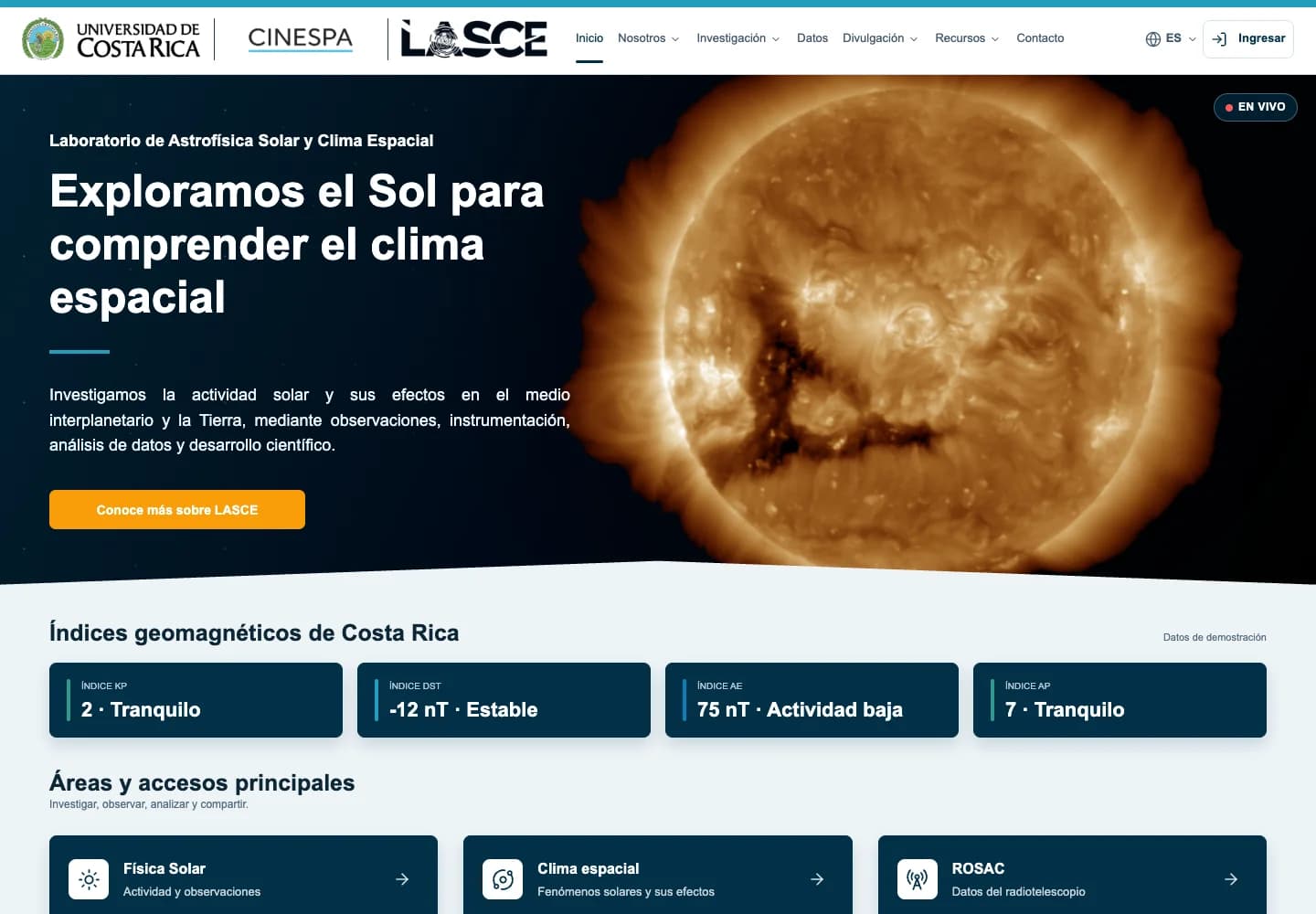
LASCE is the platform for the Universidad de Costa Rica's Space Weather Lab: a pnpm + Turborepo monorepo with a Next.js app (UI and API) and a Python worker sharing a BullMQ queue, backed by PostgreSQL, Redis, InfluxDB and MinIO. Several student teams built it together; I worked on team g02.
Research publications
- Designed a dedicated research PostgreSQL schema in Prisma (publishers, research records, authors and an ordered author join for citation order) with unique DOIs and source URLs and a date index, plus its migration and seed data.
- Mirrored the schema in SQLAlchemy for the Python worker and wrote a test that asserts the mirror matches Prisma's tables, columns and foreign keys, so the two runtimes can't drift apart.
- Replaced the page's mock data with a Server Component that reads from Postgres, built the PublicationsExplorer and PublicationCard components, and documented the schema.
A reusable in-place CMS
- An edit mode that admins toggle from the admin shell (shared through a provider), a wrapper that adds edit and delete actions to any piece of content, and an add-item card, so pages are edited where they're read.
- A shared UI kit: modal (three sizes), confirm dialog, labelled form field, file drop input, icon button, toggle and a danger button variant, each with Storybook stories and Vitest tests.
- Wrote the guide other teams follow to make their own features CMS-editable.
News management
- Article form, editable news cards and a news explorer that persists through the API instead of local state.
- Permission-gated REST routes (POST /api/news, PATCH and DELETE /api/news/[id]), with each create, edit and delete control in the UI gated by its own grant.
- Tests for the routes, the data functions and every component, plus a generic validator shared by the forms.
Home page and research areas, in both languages
- Home page management: new tables for the hero banner and the geomagnetic indices (Kp, Dst, AE, Ap) with translation tables and a migration seeded with the text the page already showed, a service and API routes, and editors in edit mode for the title, subtitle and each index in Spanish and English, with the indices reordered by dragging.
- Research areas: the visitor reads each area in the language chosen in the header, and administrators edit title and description in both languages with a shared photo. Writes are transactional and versioned so two editors can't overwrite each other, and every outcome is reported in a toast.
- A reusable TruncatedText component that cuts long text after a chosen number of lines and adds an inline "Leer más" / "Leer menos" disclosure only when the text really overflows.
- Mirrored every new table in the Python worker's SQLAlchemy models with model tests, and added a period picker (start and optional end year and month) to the gallery album form, stored in the same string format so no migration was needed.
Admin dashboard and uploads
- Built the first version of the admin dashboard (shell, sidebar, stat cards, status pills and summary page) with a Playwright end-to-end spec.
- Restricted the accepted file types for uploads to MinIO and documented the build arguments the deployment needs.
Admin panel, audit trail and download history
- Replaced the dashboard's placeholders with real data: live counts of the managed content, the state of the platform's services (a new health endpoint probing the API, workers, MinIO and InfluxDB in parallel, reachable only by admins) and recent activity.
- Auditoría: every administrative write (news, publications, research areas, gallery, home, roles and more) now records an audit event inside the same transaction as the change, so a failed write records nothing and deletes still name what was removed. Administrators browse and filter the events in a new section, behind its own permission.
- Download history: a paginated, filterable list of resource downloads (date range, source, instrument, format, user) behind a dedicated grant, with storage keys never selected. The "Modo edición" switch moved into the account menu so editors can enable it from any page.
- Translated the user management page to Spanish and English, and fixed why uploaded images never displayed on staging (the storage host wasn't reaching the image allowlist at build time), limiting the picker to accepted formats and sizes.
Data queries, the team page and admin polish
- Data query form: it now opens on the latest day that has data for the chosen instrument (allowing for the sources' one-day publication lag), reads ranges that cross midnight across both days' files, works in Costa Rica time, and gives clearer errors, scrolling and focus on the results.
- A development team page, linked from the footer, crediting the nine students who built the portal and telling the project's background (origins, objectives, process and acknowledgments) in both languages, with component and end-to-end tests.
- Sprint polish across the admin panel: readable action and item labels in the audit trail, disabled buttons and a sticky unsaved-changes bar in the permissions editor with accurate descriptions, sub-albums allowed to share a title, and safer external contact links.
Built with
Next.js 16TypeScriptPrismaPostgreSQLSQLAlchemyVitestStorybookPlaywrightMinIOTurboreponext-intl
Screenshots
Next project
Wayfinders' Abacus →