
Nov 2026
Built agentically with Claude Code
The Gilded Quill
A self-hosted, real-time collaborative LaTeX editor dressed as a medieval tavern: live co-editing, server-side PDF compiles, version history, and an MCP server so AI assistants can work on documents too. Built in eleven days through agentic programming with Claude Code.
My roleCreator: product direction, design decisions, review and deployment, with Claude Code writing the code as the agent
- days of development
- 11
- days of development
- commits
- 79
- commits
- lines of Rust
- 6.6k
- lines of Rust
- lines of TypeScript, HTML and SCSS
- 21k
- lines of TypeScript, HTML and SCSS
- Rust tests
- 78
- Rust tests
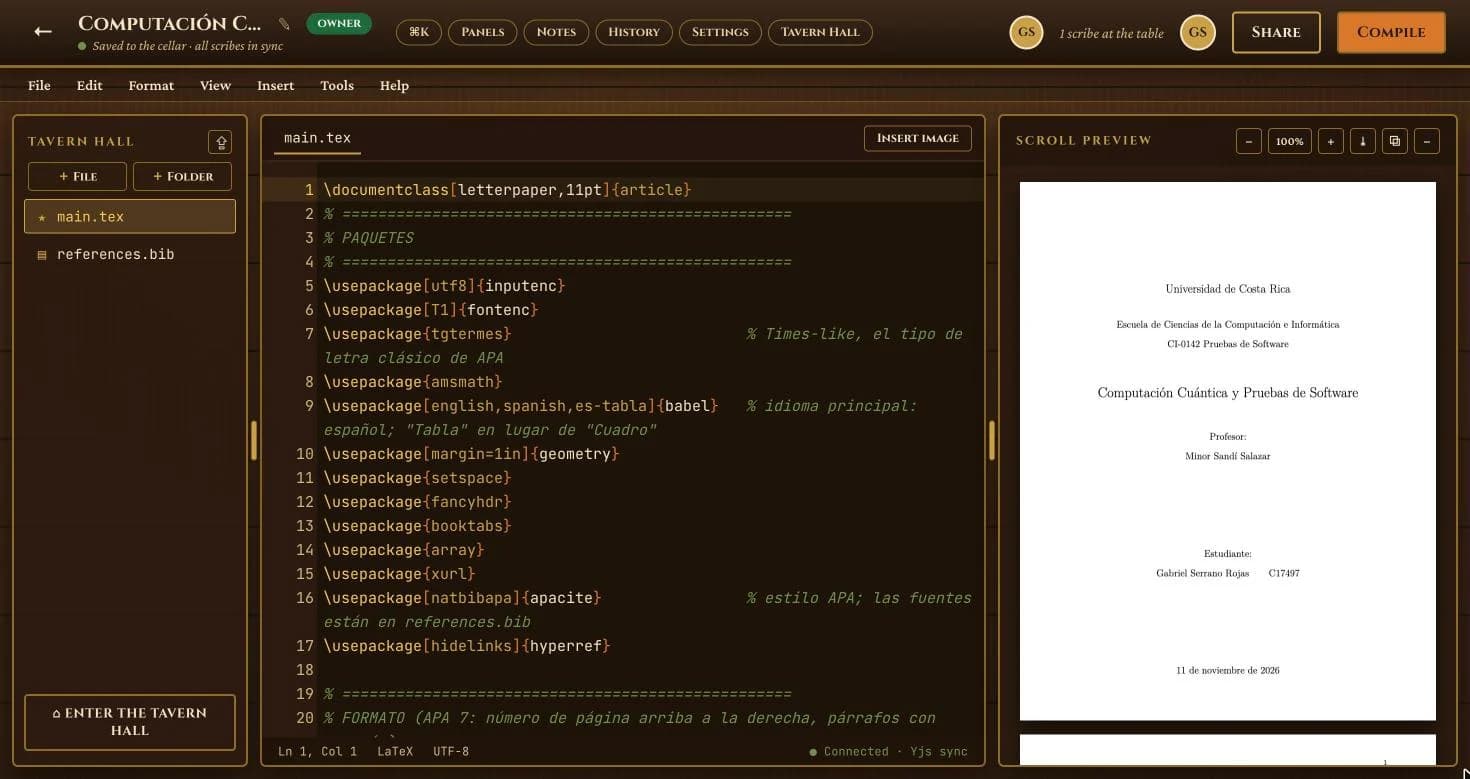
The Gilded Quill is an open-source, Overleaf-style editor that anyone can run with Docker. Documents are scrolls, the people editing them are scribes, a scroll's files sit at tables in the Tavern Hall, and the compile output is the Ink Log.
It's an experiment in agentic programming: I acted as product owner and reviewer, deciding what to build, how it should feel and what was good enough, while Claude Code planned and wrote the Rust backend, the Angular frontend, the tests and the deployment. The point of this project is the scope that approach reached in under two weeks.
Writing together
- Live co-editing over WebSockets with a CRDT (Yjs in the browser, Yrs on the server): remote cursors, selections and presence, and offline edits that merge when you reconnect.
- A LaTeX-aware CodeMirror editor: autocomplete for commands, environments, \ref labels, \cite keys from .bib files and file paths; search and replace across every file; threaded margin notes with @mentions.
Compiling
- Compiles run on the server in a bounded worker pool of Tectonic processes with a timeout, and the PDF preview follows the latest build for everyone at the table.
- Double-click the PDF to jump to the source line and word that produced it (SyncTeX); errors in the Ink Log link to their file and line.
Accounts, sharing and AI assistants
- Email and password (Argon2id), magic links, verification, lockout and per-IP rate limits; owner, scribe and reader roles enforced on the server, with invites and share links.
- An MCP server lets Claude Code, Codex or Claude Desktop read, search, edit and compile a scroll with a personal token. Their edits are held for review in a side-by-side diff unless the owner lets them apply directly, and the assistant shows up at the table with its logo while it works.
Built with
Screenshots
Next project
Mi VuelTica →